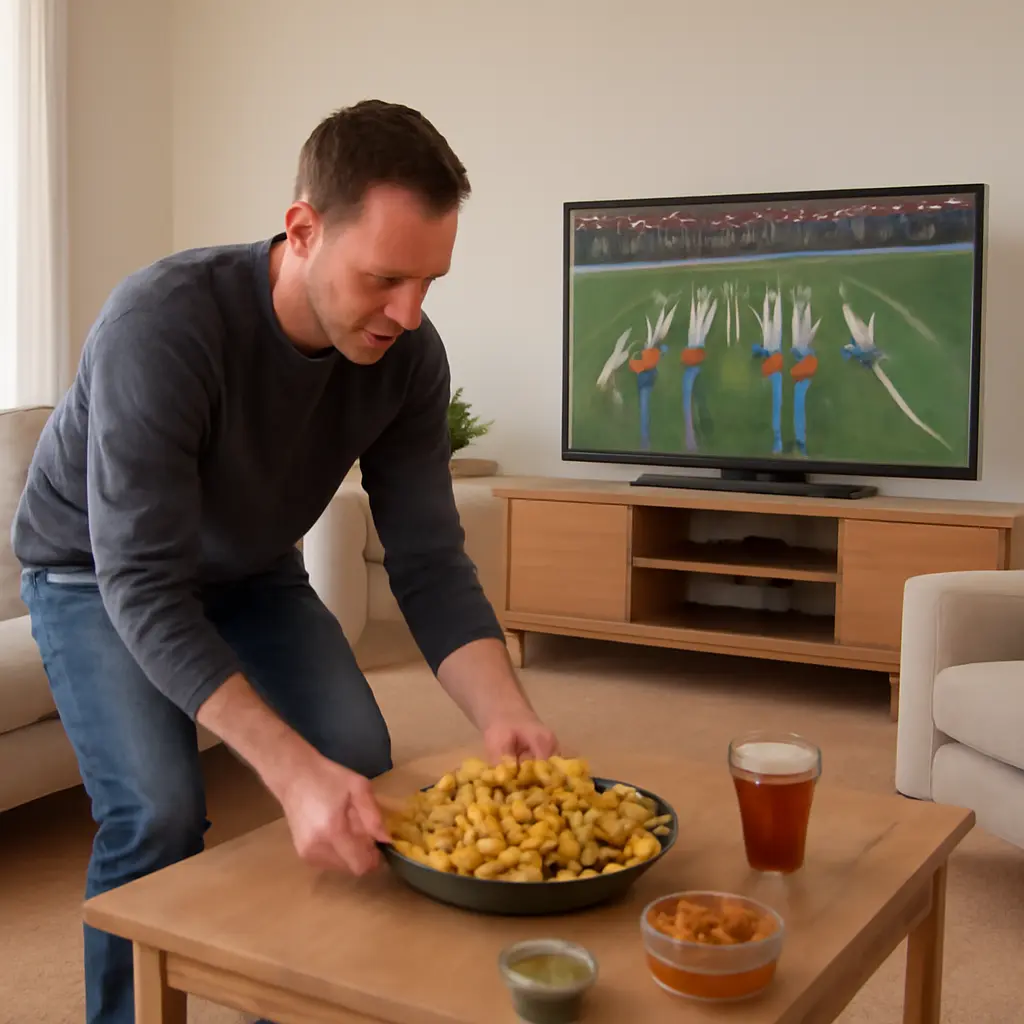
Nachos and football Sunday make a powerful pairing because they combine rewarding flavors, shared rituals, and the suspense of live sport. Psychology helps explain the appeal: sensory variety and anticipation can heighten enjoyment, while eating together can strengthen social connection. The scale of the occasion is substantial: the National Retail Federation estimated that At least 200.5 million adults planned to watch Super Bowl LVIII in 2024, with many celebrating around food. These mechanisms illuminate why a crunchy, savory platter can feel especially satisfying on game day—and why portions, attention, and the social setting matter.
Why Nachos and Football Sunday Create a Rewarding Ritual
The “nachos-and-football” experience is a food-and-sport ritual: a repeated occasion that links a familiar snack with shared viewing and emotional anticipation. It is not a formal clinical or scientific category. Rather, it brings together established ideas from sensory psychology, reward learning, attention, and social eating. Football supplies suspense and conversation; nachos offer crisp texture, rich flavor, and easy sharing. Their combination turns an ordinary meal into a recognizable event.
The ritual’s appeal depends on more than hunger. A touchdown, a close score, or a familiar weekly kickoff can become a cue for excitement, while the food provides a predictable source of pleasure. Understanding these ingredients helps explain the feeling of “football Sunday bliss” without claiming that any one snack or sport produces the same response in everyone.
Sensory Reward Explains the Appeal of Nachos
Sensory reward refers to the pleasure and motivation generated by a food’s perceived qualities, including taste, smell, texture, and appearance. Psychologist and food researcher Charles Spence has described eating as a multisensory experience: flavor is shaped not only by taste and smell but also by texture, sound, sight, and expectations. Nachos bring several of these cues together in a single bite.
The classic combination includes crisp tortilla chips, melted cheese, salt, and toppings such as salsa, beans, jalapeños, or sour cream. These components create contrast and variety. The crunch produces an audible and tactile signal; warm, creamy toppings contrast with crisp chips; and savory, spicy, tangy, or cooling flavors can alternate from bite to bite. This sensory complexity helps make nachos distinctive, though it does not mean they are uniquely irresistible or that everyone experiences them the same way.
Crunch, Contrast, and Flavor Variety
Crunch is a texture and sound cue that can make food seem fresh and satisfying. Nachos also offer what researchers call sensory variety: changing combinations of taste and texture within one eating occasion. A bite with salsa and jalapeño can feel different from one with cheese and beans, making a shared platter more varied than a uniform snack.
Variety can encourage people to continue eating because each new flavor or texture renews interest. That is one reason a large platter can be easy to graze from while attention is elsewhere. The practical implication is simple: serve a planned amount, add filling toppings such as beans or vegetables, and keep extra chips separate so that the supply does not expand unnoticed.
Portion Size and Mindless Snacking
Mindless eating occurs when people eat with limited awareness of how much they have consumed, often because attention is focused on another activity. Watching a game, talking, and reaching into a shared bowl can make it harder to notice portions or satiety. In a well-known laboratory study, Brian Wansink and colleagues found that people given continuously replenished soup bowls ate more than those with ordinary bowls, illustrating how eating cues and serving conditions can influence intake. The study was conducted in a specific experimental setting, so it should not be treated as a precise prediction of what every fan will eat.
A football gathering can make the same principle relevant: an open-ended platter invites repeated reaching. Portioning chips into smaller dishes, setting out water, and pairing chips with vegetables, beans, or protein can make the spread easier to navigate. These are practical choices, not rules for enjoying the game.
Anticipation and Football’s Emotional Rhythm
Anticipation is the expectation of a future event and its possible reward. In football, the next play, a possible score, or a late-game comeback can hold attention because the outcome is uncertain. Behavioral research distinguishes the pleasure of receiving a reward from the motivation and expectation that arise while waiting for it. On game day, that anticipation can make the entire viewing occasion feel charged, including its food rituals.
The sport’s emotional rhythm also matters. Fans experience changing levels of suspense, relief, disappointment, and celebration. A familiar snack can become associated with those moments through repetition: chips arrive before kickoff, the platter is refreshed at halftime, or guests gather around the food after a big play. The association is learned through experience; it is not an automatic psychological effect of nachos.
Ritual, Familiarity, and Learned Cues
A ritual is a repeated action that gains meaning through its context. Research by Kathleen Vohs and colleagues has found that performing simple rituals before eating can increase enjoyment in some experimental conditions, partly by encouraging attention to the experience. This does not establish that every game-day routine makes food taste better, but it supports the broader idea that structured, meaningful actions can shape how an occasion is experienced.
For fans, setting out a familiar recipe or sharing a customary halftime snack can signal that the gathering has begun. These cues help distinguish game day from an ordinary Sunday. They can also create continuity across seasons, making the food part of a social memory rather than merely a source of calories.
Attention, Suspense, and the Viewing Experience
A close game naturally draws attention toward the screen, while food and conversation compete for it. This divided attention can make eating feel casual and automatic, but it can also make shared snacks useful: guests can serve themselves without interrupting the game. The experience is shaped by the match’s pace, the company present, and whether viewers are actively following the sport or treating it as background entertainment.
A useful way to enjoy both is to pause briefly during halftime or between games, check in with hunger, and notice the food’s flavor and texture. Such pauses preserve the easygoing nature of a watch party while helping people stay aware of their choices.
Social Eating Strengthens Football Sunday Bliss
Social eating is the act of sharing food in the company of others. Research reviews by John de Castro and colleagues have found that people often eat more when dining with others than when eating alone, with the size of the effect varying according to the group and situation. Shared meals can also support conversation, belonging, and enjoyment. The food’s social meaning may therefore matter as much as its taste during a football gathering.
Nachos suit group viewing because they are easy to place at the center of a table and customize with toppings. The platter gives guests a common point of attention and a low-effort way to participate. The National Retail Federation’s estimate that at least 200.5 million adults planned to watch Super Bowl LVIII in 2024 underscores the enormous scale of the social viewing occasion, although that figure describes intended viewership—not the number of people who ate nachos or gathered in groups.
Sharing, Conversation, and Belonging
A communal platter can encourage small exchanges: passing a bowl, recommending a topping, or comparing preferences. These interactions turn food into a social object. The shared activity can include fans and nonfans alike, since people may join for the company, the meal, or the spectacle rather than close interest in the game.
Hosts can make that welcome more inclusive by offering clearly labeled toppings and alternatives for common dietary needs. Serving salsa, cheese, beans, and vegetables separately lets guests choose their own combinations and helps accommodate different tastes without changing the shared ritual.
A Real-World Example: The Super Bowl Gathering
The Super Bowl is a clear example of sport, food, and social ritual converging at national scale. In its 2024 game-day survey, the National Retail Federation reported that 200.5 million adults planned to watch, and estimated expected spending on food, beverages, apparel, decorations, and other items. Those figures show the commercial and cultural reach of the event, not a direct measure of psychological happiness or snack consumption.
At a household level, the same pattern appears in a smaller form: friends arrive before kickoff, food is available throughout the broadcast, and key plays become shared stories. Nachos fit the setting because they are customizable and shareable. The combination of a common event, familiar food, and group participation provides a grounded explanation for why the day can feel especially enjoyable.
A More Mindful Way to Enjoy Game-Day Nachos
Enjoyment and moderation do not have to compete. The goal is not to remove the ritual but to make it intentional. Serving food in a defined place, adding fresh toppings, and taking occasional breaks can help guests enjoy the meal while staying engaged with the game and one another.
- Build flavor and texture variety with salsa, vegetables, beans, and a range of toppings.
- Serve a portion on a plate or in a small bowl instead of relying only on a large, continuously replenished platter.
- Offer water and non-alcoholic drinks alongside other beverages.
- Keep dietary needs in mind by separating toppings and labeling ingredients.
- Make room for the social ritual itself: conversation, shared anticipation, and the pleasure of watching together.
Conclusion: The Psychology Behind Nachos and Football Sunday Bliss
The psychology of football Sunday bliss rests on several connected factors: sensory reward makes nachos appealing through crunch and contrast; anticipation gives the game its emotional charge; learned rituals link familiar foods with kickoff and halftime; and social eating turns a snack into a shared experience. Large-scale events such as the Super Bowl show how widespread these gatherings can be, while research on attention and group eating suggests why a little planning can make the occasion more comfortable.
For a satisfying game day, enjoy the flavors, share the food, and stay aware of portions without losing the fun. Consider exploring research on multisensory eating, food rituals, and social meals to learn more about how everyday habits shape pleasure and connection.
Sources: National Retail Federation, Super Bowl LVIII: 200.5 Million Americans to Watch the Big Game, 2024, https://nrf.com/media-center/press-releases/super-bowl-lviii-2005-million-americans-watch-big-game; Spence, Charles, “Multisensory Flavor Perception,” Cell, 2015, https://doi.org/10.1016/j.cell.2015.03.007; Wansink, Brian, James E. Painter, and Jill North, “Bottomless Bowls: Why Visual Cues of Portion Size May Influence Intake,” Obesity Research, 2005, https://doi.org/10.1038/oby.2005.12; Vohs, Kathleen D., et al., “Rituals Enhance Consumption,” Psychological Science, 2013, https://doi.org/10.1177/0956797613478949; de Castro, John M., “Social Facilitation of Food Intake in Humans,” Appetite, 1994, https://doi.org/10.1006/appe.1994.1016.