
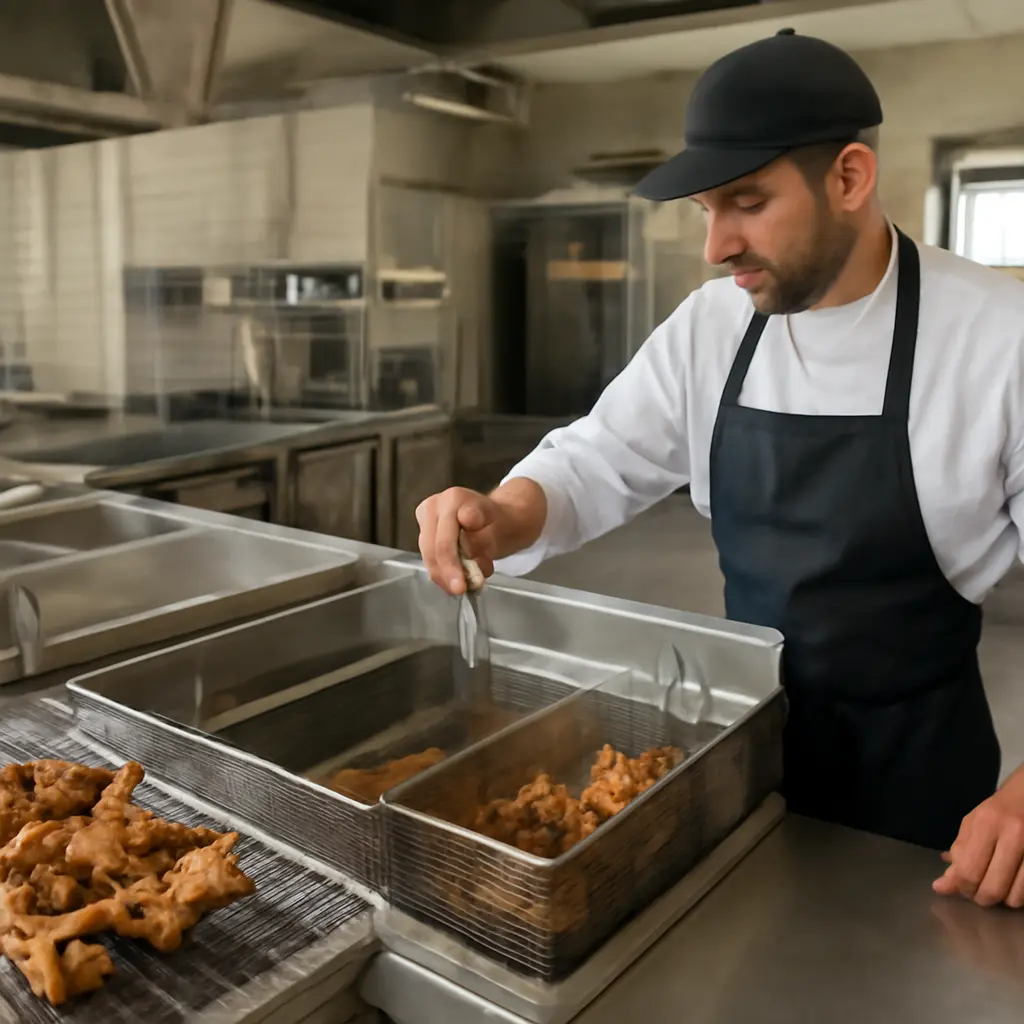
Sports-bar wings get their crunch from a sequence of practical choices: drying the skin, managing moisture and temperature, frying in batches, and saucing only after cooking. The U.S. Department of Agriculture recommends cooking poultry to 165°F (74°C), while food-science research explains why rendering fat and evaporating surface moisture help create a crisp crust. These principles clarify what happens behind the fryer, how breaded and unbreaded wings differ, and how restaurants balance texture, safety, speed, and flavor.
Frying technique shapes sports-bar wing crunch
A chicken wing’s crunch is the crisp, browned exterior produced when heat removes water from the skin or coating while fat renders and the surface undergoes browning. Food scientist Harold McGee describes frying as a process in which hot oil transfers heat efficiently to food; surface water escapes as steam, helping the exterior dry and become crisp. A wing can be cooked through yet remain soft if its surface is wet, crowded, or coated in sauce too early.
There is no single universal sports-bar recipe. Common approaches include naked wings, lightly floured wings, and wings coated in a batter or breading. Each can produce crunch, but they rely on different structures: crisped skin, a thin dehydrated coating, or a thicker browned shell. The shared challenge is controlling moisture without compromising food safety.
Dry skin and surface moisture
Drying the wings before frying reduces the water that must evaporate from their surfaces. Kitchens may pat them dry, leave them uncovered under refrigeration, or use a light coating of starch or flour. These steps do not make the interior dry; rather, they help the exterior crisp sooner. McGee’s food-science explanations emphasize that water must escape before a dry, browned surface can develop.
A refrigerator’s moving, relatively dry air can help dry exposed skin during a controlled rest. That is a preparation technique, not a food-safety shortcut: raw poultry should remain refrigerated and be handled separately from ready-to-eat foods. The USDA advises keeping perishable food at 40°F (4°C) or below and cooking poultry to 165°F (74°C).
Oil temperature and batch control
Hot oil cooks the exterior rapidly, but adding too many cold wings at once can pull down the oil temperature. The result may be slower cooking and a greasier, less crisp surface. Restaurant fryers therefore rely on consistent portions, sufficient recovery time, and temperature monitoring. The exact operating temperature varies by recipe and equipment; the key is using a tested method that crisps the coating while bringing every wing to a safe internal temperature.
A thermometer provides a more reliable safety check than color or crispness alone. The USDA’s 165°F recommendation applies to poultry, including wings. A browned exterior does not prove that the meat has reached that temperature, just as a safe interior temperature does not guarantee a crunchy skin.
Wing coatings create different kinds of crispness
Coating is the next choice after moisture and heat management. A coating changes the wing’s surface area, texture, and ability to hold sauce. Naked wings emphasize rendered skin; flour- or starch-dusted wings form a thin crust; breaded wings create a thicker, more familiar crunch. These are related but distinct versions of the same goal: a dry, structurally crisp exterior surrounding juicy meat.
Naked wings: crispness from skin
Naked wings are fried without a substantial flour or breadcrumb layer. Their crunch comes primarily from drying and browning the skin as its fat renders. This style can taste especially chicken-forward, but it depends heavily on good surface drying and fryer management because there is no separate crust to compensate for soft skin.
Flour and starch: a thin, craggy crust
A light dusting of flour or starch forms a thin outer layer that dries and browns during frying. Starch-based coatings can feel particularly brittle and crisp, while flour contributes a more familiar, lightly bready crust. The coating must be applied consistently: too little may leave patchy coverage, while excess powder can create a heavy or chalky finish.
Some cooks use a small amount of baking powder in a dry seasoning mixture to encourage a rougher, crisp surface. This is a recipe technique, not a substitute for safe cooking or careful temperature control. Commercial kitchens generally standardize their coating mixture and portion sizes so each order cooks predictably.
Battered or breaded wings: a thicker shell
Battered and breaded wings gain crunch from a coating that surrounds more of the meat than a light dusting does. A well-applied shell can provide a pronounced bite and a surface that catches sauce. However, a thick coating can soften if it absorbs liquid, so timing matters: wings are typically sauced close to serving rather than left to sit in sauce.
Saucing and service determine how long wings stay crisp
Crispness does not end when a wing leaves the fryer. Steam trapped in a covered container and water in a sauce can soften a crust. Many kitchens therefore drain wings briefly, toss them with sauce shortly before service, and avoid stacking them in ways that trap steam. A wire rack can allow air to circulate better than a flat, absorbent surface during a short holding period.
Sauce timing and texture
Buffalo-style sauces commonly combine hot pepper sauce with fat, often butter or a butter-like ingredient. The sauce’s liquid can migrate into a crisp coating over time. Tossing just before serving preserves more crunch than saucing early, while serving extra sauce on the side gives diners control over the coating.
Holding, packaging, and the delivery problem
Wings continue to lose crispness when moisture is trapped around them. Tight lids, long waits, and sealed delivery packaging can hold steam against the crust. Restaurants can reduce—but not eliminate—this effect by limiting hold time, keeping sauces separate when appropriate, and choosing packaging that allows some ventilation. These steps illustrate why an excellent fryer result may not arrive at the table in exactly the same condition.
Food safety and fryer operations support consistent wings
Crunch is a quality measure; safe internal temperature is a food-safety measure. Neither replaces the other. The USDA’s consumer guidance sets 165°F (74°C) as the safe minimum internal temperature for poultry, measured with a food thermometer. In commercial kitchens, staff also need procedures for raw-poultry storage, handwashing, sanitizing, and avoiding cross-contamination.
Temperature checks and responsible handling
Because wing size and fryer loads vary, time alone cannot guarantee doneness. A thermometer should be placed in the thickest meaty portion without touching bone. Raw wings should be kept apart from cooked food and clean utensils, and refrigerated promptly. For restaurant operators, the FDA Food Code provides a model for retail food-safety practices, while local authorities determine the rules that apply in a particular jurisdiction.
A practical quality checklist
- Keep raw wings refrigerated and prevent cross-contamination.
- Dry the surface and apply any coating consistently.
- Fry controlled batch sizes so oil temperature can recover.
- Verify safe doneness with a thermometer; poultry should reach 165°F (74°C).
- Drain briefly, sauce near service, and avoid trapping steam during holding.
Conclusion: the crunch comes from coordinated choices
Sports-bar wing crunch is not a mystery ingredient. It comes from managing surface moisture, choosing a coating style, controlling fryer batches, and serving wings before steam and sauce soften their exterior. Naked, lightly coated, and breaded wings each use a different route to crispness, while safe handling and the USDA’s 165°F poultry-temperature guidance remain essential throughout.
For a home trial, compare the same wing preparation across two coating styles, use a thermometer, and sauce only at the last moment. For further reading, consult USDA poultry-safety guidance and the FDA Food Code alongside food-science explanations of frying and moisture loss.
Sources: U.S. Department of Agriculture, Safe Minimum Internal Temperature Chart, https://www.fsis.usda.gov/food-safety/safe-food-handling-and-preparation/food-safety-basics/safe-temperature-chart; U.S. Department of Agriculture, Chicken from Farm to Table, https://www.fsis.usda.gov/food-safety/safe-food-handling-and-preparation/poultry/chicken-farm-table; U.S. Food and Drug Administration, Food Code 2022, https://www.fda.gov/food/fda-food-code/food-code-2022; Harold McGee, On Food and Cooking: The Science and Lore of the Kitchen, Scribner, 2004.


