
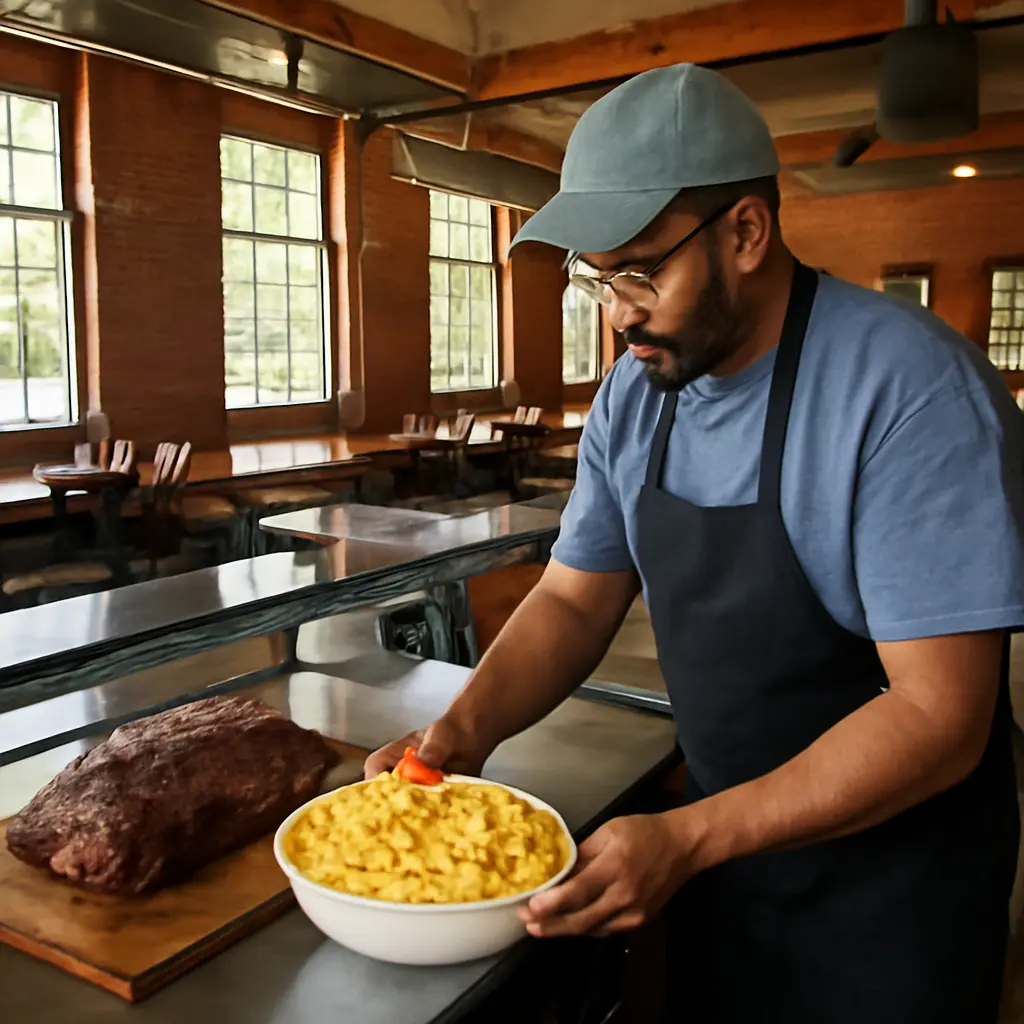
Mac and cheese is a baked or stovetop dish of pasta coated in a cheese-based sauce, and it has become one of barbecue’s most-requested comfort-food sides. Its rise reflects a practical pairing: creamy, filling pasta contrasts with smoky, savory barbecue, while restaurants can adapt it with brisket, bacon, peppers, or regional cheeses. Barbecue menus and restaurant-industry research point to the dish’s broad appeal, though no single national dataset ranks mac and cheese as the most-requested barbecue side across all restaurants. Its popularity is best understood through its menu role, flavor and texture, regional variations, and the economics of serving a familiar favorite.
Mac and cheese’s role as a barbecue comfort-food favorite
“Mac and cheese” has no single authoritative culinary definition, but it commonly means cooked macaroni or another pasta combined with cheese sauce, sometimes finished with a baked crust. The National Museum of American History documents an early American macaroni recipe associated with Thomas Jefferson and James Hemings, helping explain the dish’s long place in U.S. food culture. At barbecue restaurants, the classic side has evolved into a flexible menu category rather than one fixed recipe.
Calling it barbecue’s most-requested comfort food captures a visible menu trend, not a verified nationwide ranking. The National Restaurant Association’s industry reporting tracks broad consumer and restaurant trends, but does not establish a universal barbecue-side leaderboard. Restaurant menus, local customer polls, and individual operators’ sales figures can show strong demand in particular markets; those measures should not be mistaken for a national count. Still, mac and cheese appears widely alongside smoked meats because it is familiar, substantial, and easy to customize.
A familiar side with deep American roots
The dish’s history helps account for its comfort-food status. The Smithsonian’s National Museum of American History connects an early macaroni recipe to Jefferson and Hemings, while the packaged dinner popularized by Kraft in 1937 made a quick, affordable version accessible to many households. That history spans home cooking, convenience food, and restaurant dining—three settings that keep the flavor recognizable even when barbecue cooks add their own signature ingredients.
A contrast to smoke, spice, and rich meat
Barbecue often brings smoky aromas, browned edges, spice rubs, and rich meat. A creamy cheese sauce and soft pasta offer a contrasting texture and a mild, savory flavor. This pairing can make a plate feel balanced in experience, even though both the meat and side may be rich. The contrast also makes mac and cheese approachable for diners who prefer a less spicy or less smoky part of the meal.
Barbecue mac and cheese’s defining attributes
Barbecue mac and cheese is a variation of the classic pasta-and-cheese dish made to complement smoked or grilled food. Its defining attributes are a creamy or baked cheese base, a texture that holds up on a full barbecue plate, and optional ingredients that echo the restaurant’s meats, sauces, and regional style. Those attributes produce several related forms, from traditional baked macaroni to brisket-topped bowls.
Creamy, baked, and smoked styles
Creamy mac and cheese is usually stirred together on the stovetop and served soft, while baked versions are finished in an oven for a firmer center and browned top. Some barbecue kitchens smoke the assembled dish or use smoked cheese to connect its flavor to the pit. These are not strictly standardized categories: restaurants may combine methods, and “smoked mac and cheese” can describe either the cooking process or an ingredient’s flavor.
Regional cheeses and signature add-ins
Cheese choices shape both flavor and texture. Cheddar offers a familiar sharpness; Monterey Jack melts smoothly; pepper jack adds heat; and smoked gouda can reinforce a smoky profile. Restaurants may also fold in jalapeños, green chiles, caramelized onions, or barbecue sauce. These additions turn a standard side into a menu signature while preserving the dish’s recognizable pasta-and-cheese foundation.
Brisket, pulled pork, and loaded bowls
Loaded mac and cheese makes the side a main course by adding chopped brisket, pulled pork, sausage, or bacon. The format is especially useful for restaurants: it can feature existing smoked meats and offer customers a more filling option without introducing an entirely separate protein. Toppings vary by region and operator, so a loaded bowl may include pickles, scallions, crispy onions, or a drizzle of sauce.
Why mac and cheese works on barbecue menus
The dish’s popularity is not only a matter of taste. Familiarity, flexibility, and operational convenience help explain why it earns a place beside ribs, pulled pork, and brisket. It can serve children and adults, appear as a side or entrée, and use ingredients already stocked for other dishes. These practical benefits connect consumer appeal with restaurant menu strategy.
Broad appeal across ages and dining occasions
Pasta and cheese are widely recognizable foods, making mac and cheese a low-risk choice for diners ordering an unfamiliar barbecue specialty. It fits family meals, casual lunches, takeout, and group catering. The National Restaurant Association’s research on consumer dining behavior emphasizes convenience and value as recurring considerations; a hearty side that can be ordered individually or shared fits those priorities, although that research does not specifically prove mac and cheese is the top barbecue side.
Menu flexibility and restaurant operations
A restaurant can prepare a base recipe in batches, then finish portions with different cheeses or toppings. That approach supports menu variety without requiring a separate cooking system for every variation. It can also help operators use trimmings or portions of smoked meat in a value-added dish. Actual labor savings and profitability depend on recipe, portion size, ingredient costs, and food-safety procedures; the dish is not automatically inexpensive simply because its ingredients are familiar.
Comfort food and changing consumer expectations
Comfort food often evokes familiarity, satisfaction, and a sense of indulgence. Barbecue restaurants build on those associations by pairing macaroni with traditional pit-smoked meats, while contemporary versions may add premium cheeses, house-made sauces, or locally inspired ingredients. The result bridges nostalgia and novelty: customers recognize the dish but can still find a version unique to a particular restaurant.
Nutrition, portions, and menu transparency
Mac and cheese can be energy-dense because recipes commonly combine pasta, cheese, milk, butter, and sometimes meat or a buttery topping. Nutrition varies substantially with ingredients and serving size, so a single calorie figure cannot represent every restaurant recipe. The U.S. Food and Drug Administration requires covered chain restaurants and similar retail food establishments to provide calorie information for standard menu items, giving diners a way to compare portions where the rule applies.
What changes a serving’s nutrition
Portion size, cheese quantity, added cream or butter, and toppings all affect a serving’s energy, saturated fat, and sodium. A side portion is different from a loaded entrée topped with brisket and sauce. The USDA FoodData Central database provides nutrient data for individual foods and ingredients, but restaurant recipes require ingredient-specific calculations or laboratory analysis for an accurate estimate.
Practical choices for diners
Diners who want a smaller meal can share a side, request a smaller serving where available, or pair it with vegetables and leaner barbecue portions. Customers with allergies or dietary restrictions should ask about dairy, wheat, meat ingredients, and cross-contact. Vegan and gluten-free versions exist, but preparation methods and ingredient substitutions differ by restaurant, so menu labels alone may not answer every safety question.
Conclusion: a classic side with room to evolve
Mac and cheese has become a defining comfort-food option on many barbecue menus because its familiar, creamy character contrasts with smoked meats, adapts easily to regional flavors, and works as either a side or a loaded entrée. Its history—from early American macaroni recipes to convenient packaged dinners—helps explain its broad recognition, while restaurant flexibility gives it continuing relevance. The claim that it is barbecue’s single most-requested side should be treated as a trend description rather than a proven national statistic. Diners can explore regional versions, check portion and ingredient details, and compare restaurant nutrition information; operators can keep the dish appealing through transparent menus and thoughtful variations.
Sources: National Museum of American History, “Thomas Jefferson and the Origins of Macaroni and Cheese,” https://americanhistory.si.edu/explore/stories/thomas-jefferson-and-origins-macaroni-and-cheese; Kraft Heinz, “Kraft Macaroni & Cheese,” https://www.kraftheinz.com/kraft-mac-and-cheese; National Restaurant Association, Research and Reports, https://restaurant.org/research-and-media/research/; U.S. Food and Drug Administration, “Menu Labeling Requirements,” https://www.fda.gov/food/food-labeling-nutrition/menu-labeling-requirements; U.S. Department of Agriculture, FoodData Central, https://fdc.nal.usda.gov/.


